
 English
 Tiếng Việt

NUTRITION FOR RICE DURING THE SPROUTING - TILLERING STAGE
08 Jul 2026
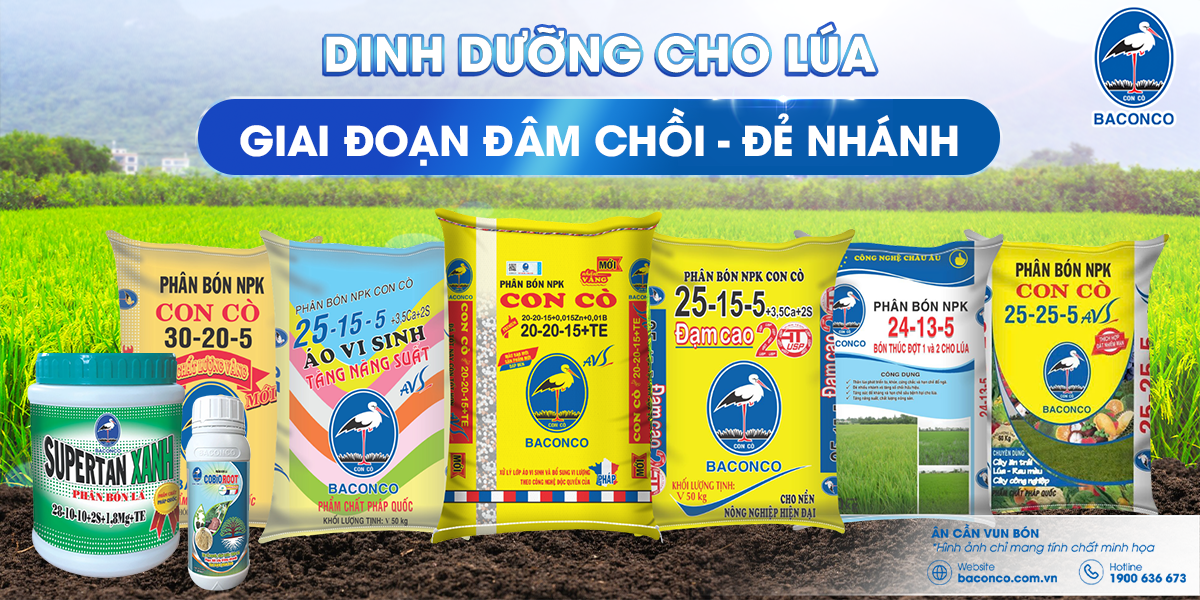
Nutrition for rice during the sprouting - tillering stage helps plants develop strong roots, tiller evenly and build a good yield foundation.
Nutrition for rice during the sprouting - tillering stage helps plants grow strongly at the beginning of the crop
Nutrition for rice during the sprouting - tillering stage is an important factor in the early period after sowing, when rice plants begin forming their root system, developing stems and leaves, and preparing for the tillering process. This stage plays a key role in building the initial growth foundation of the rice field.
When supplied with balanced nutrition, rice plants can develop a healthy root system, absorb nutrients more effectively, achieve healthy tillering and grow more evenly. On the other hand, if nutrition is insufficient or the field is affected by acid sulfate soil or organic toxicity, rice plants may become weak, yellow, slow to tiller and affected in the number of panicles later.
To support farmers in caring for rice at the right stage, Baconco suggests nutrition for rice during the sprouting - tillering stage with suitable NPK Baconco products, combined with foliar nutrition in cases of acid sulfate soil or weak plant growth.
The role of nutrition for rice during the sprouting - tillering stage
Nutrition for rice during the sprouting - tillering stage should focus on the elements that help plants develop roots, stems, leaves and early shoots. In particular, Nitrogen (N), Phosphorus (P), Potassium (K), along with secondary and micronutrients, play an important role in supporting rice plants to tiller and grow evenly.
Nitrogen (N) helps rice plants develop stems and leaves, increase the number of shoots and support healthy tillering. When Nitrogen (N) is lacking, plants are usually short, pale yellow and poor at tillering. However, excessive Nitrogen (N) may make rice too lush, more prone to lodging and increase pest and disease pressure.
Phosphorus (P) supports a healthy root system, helping rice plants tiller earlier and more uniformly. This element is especially important in fields with acid sulfate soil or fields where the root system develops poorly at the beginning of the crop.
Potassium (K), secondary nutrients and micronutrients help plants become sturdier, with thicker leaves and better leaf posture. They also support photosynthesis and help plants better withstand unfavorable weather conditions.
NPK Baconco solutions for rice during the sprouting - tillering stage
During the sprouting - tillering stage, farmers can refer to NPK Baconco products with suitable Nitrogen (N) and Phosphorus (P) content to support root development, tillering and even plant growth.
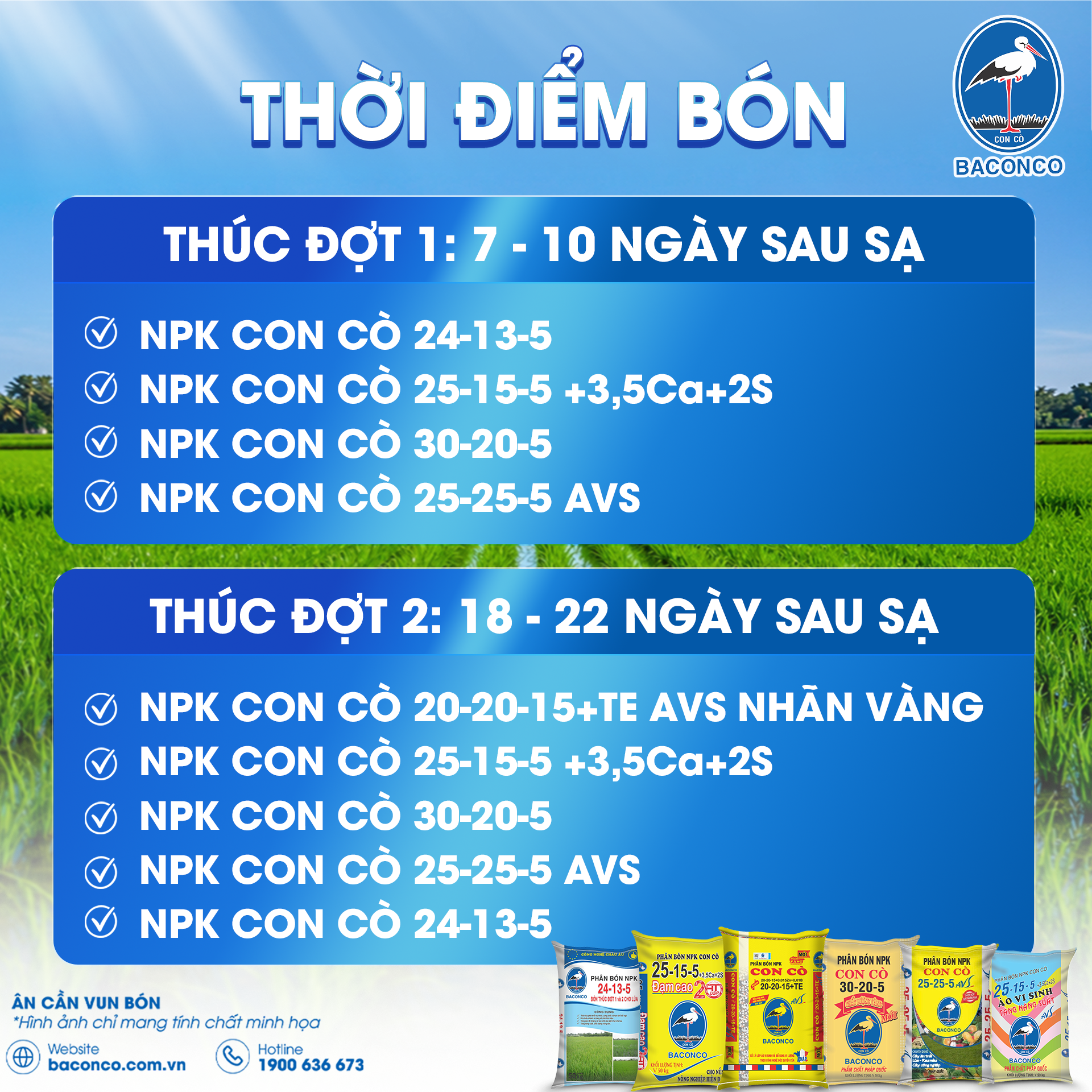
For the first topdressing, from 7 - 10 days after sowing, farmers can refer to one of the following NPK Baconco products:
NPK CON CÒ 24-13-5
NPK CON CÒ 25-15-5+3.5Ca+2S
NPK CON CÒ 30-20-5
NPK CON CÒ 25-25-5 AVS
For the second topdressing, from 18 - 22 days after sowing, farmers can continue using suitable NPK Baconco products such as:
NPK CON CÒ 24-13-5
NPK CON CÒ 25-15-5+3.5Ca+2S
NPK CON CÒ 30-20-5
NPK CON CÒ 25-25-5 AVS
NPK CON CÒ 20-20-15+TE AVS NHÃN VÀNG
The recommended dosage for each application is 100 - 150 kg/ha, depending on field conditions, rice variety, soil fertility and actual weather conditions.
Supplementary nutrition for acid sulfate soil or organic toxicity
For fields affected by acid sulfate soil or rice plants that are yellow and weak at the beginning of the crop, farmers can supplement foliar nutrition with suitable products to support root recovery and help plants grow more stably.
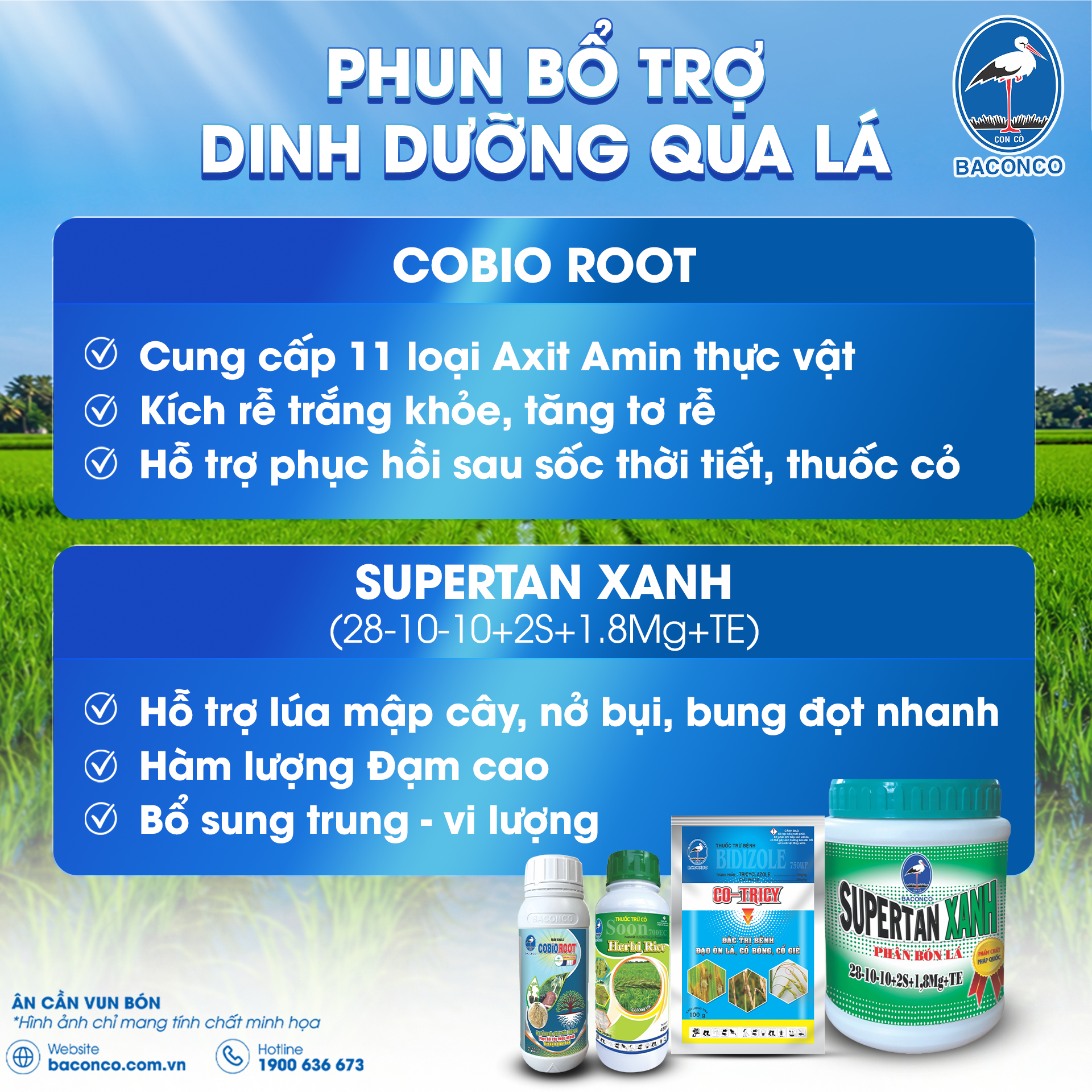
COBIO ROOT provides 11 types of plant-based Amino Acids, supporting the development of white, healthy roots, increasing root hairs and helping plants recover after weather stress or herbicide stress.
SUPERTAN XANH, with the formula 28-10-10+2S+1.8Mg+TE, contains high Nitrogen (N) combined with easily available secondary and micronutrients, helping rice plants become stronger, tiller better and develop shoots quickly.
Applying the right nutrition for rice during the sprouting - tillering stage will help plants recover better, reduce weakness and create favorable conditions for healthy tillering to occur more uniformly.
Technical notes for early-season rice care
For nutrition for rice during the sprouting - tillering stage to be more effective, farmers should combine fertilization with water, weed and pest management from the beginning of the crop.
Farmers should maintain a water level of about 2 - 5 cm in the field and avoid prolonged deep flooding. Alternate wetting and drying can be applied to stimulate a healthy root system and reduce toxic gases in the soil.
In addition, weeds should be controlled early to reduce nutrient competition with rice plants. Farmers can refer to HERBI RICE at the early post-emergence stage when weed management is needed in the field.
From 20 - 35 days after sowing, farmers should visit the field regularly to monitor leaf blast and other harmful factors. CO-TRICY can be considered when disease management is needed according to suitable technical guidance.
Conclusion
Nutrition for rice during the sprouting - tillering stage is an important foundation that helps plants develop strong roots, tiller evenly and grow stably at the beginning of the crop. Choosing the right NPK CON CÒ products, combined with water management, acid sulfate soil management and foliar nutrition when needed, will help farmers build a good yield foundation for the whole crop season.
Views
160